Family background and early life
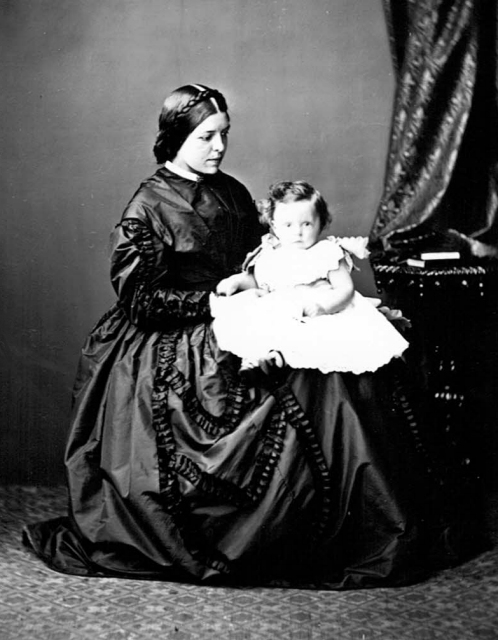
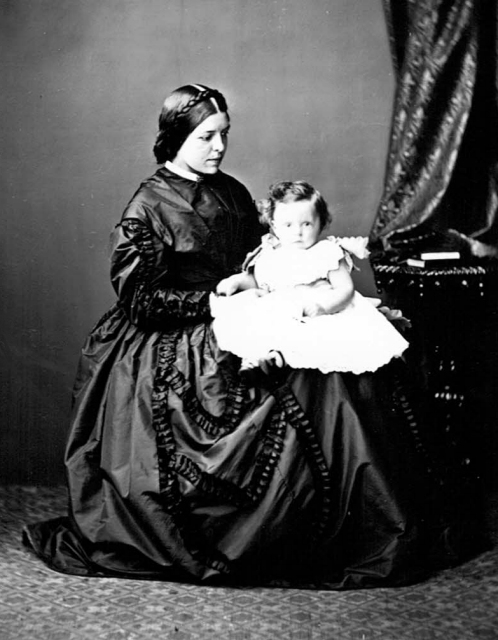
Alice Elisabeth Fanny Maule was born on 23 April 1863 at the rectory in Cheam, Surrey. She was the third of five children, and the eldest daughter, of Revd. Thomas Carteret Maule (1817–1867), who had been installed Rector of Cheam in 1856, and his wife, Julia Fanny née Bockett (1835–1892), who had married in 1857.
Alice’s father died on 29 March 1867, when she was three years old. Her mother, with her then five young children, had to leave the rectory and initially lived at a house called “Ebbisham” (a former name for Epsom), next door to the newly installed vicar of St Thomas’s Church, Henry Julian Bigsby.
Alice’s brother, Louis Carteret Maule died on 27 February 1870, aged 8, and was buried at St Dunstan’s Church on 4 March.
At the 1871 census, 7-year old Alice and her two younger siblings were living at “Ebbisham”, while their mother was visiting her sister, Sarah [Stapylton] at Gloucester Road, Kew. Her elder brothers were away at school. The family had two live in servants: 31-year old Sarah Cox, a cook, and 19-year old Grace Wood, a nurse. Grace was to remain with the family until her death in 1937, acting as Nanny to successive generations of children.
Despite being both the widow of one Anglican priest and the daughter of another, in the 1870s Julia and her children converted to the Roman Catholic Church.
In 1881, the family (Julia and her four oldest surviving children, including 17-year old Alice) were resident at 73 Warwick Gardens in Kensington, London, with two servants, 29-year old Grace Wood, now a housemaid, and 16-year old Florence Croydon, a general maid. Alice had no recorded occupation.
Marriage and children
On 20 August 1888, 25-year old Alice married 29-year old Bernard Edmondson Bishop (1859–1940) from Gravesend, at the Roman Catholic Church of the Sacred Heart in Norton Road, Hove, close to her mother’s home at Ventnor Villas. The marriage service was conducted by Revd. Father Silvester Aloysius Donnelly, who had been the priest at the church since it was opened in 1879.
Like his father, William Henry Bishop, Bernard was a stockbroker, having been admitted to the London Stock Exchange a few months before the marriage.
The couple’s first child, Dorothy Elizabeth Mary was born in Kensington on 10 November 1889, followed by the first of three sons, Cuthbert Bernard Joseph on 10 March 1891.
At the census on 5 April 1891, Alice and Bernard with their two young children were living at 44 Russell Road, Kensington. The family had four servants: 39-year old Grace Wood, now described as a “nurse” plus a sick nurse, cook and general parlourmaid.
The next son, Francis Carteret (always known by his second name) was born at Russell Road on 16 November 1892.
By mid-1896, Alice was expecting her fourth child, when the family moved to Lauriston Road, near Wimbledon Common, where their home was named “Ebbisham”, the same as the house where Alice lived following the death of her father. Here, Gerald was born on 28 December 1896.
At Wimbledon, the family doctor was Dr. Richard Austin Freeman, described by Alice’s daughter Dorothy [Moriarty] in her autobiography (written in 1989 when she was 100 years old), “Dorothy: Memoirs of a Nurse“, as:
The young doctor whose practice was building up in the skilful hands of the Jesuit fathers of Edge Hill.
“A very able man. Tragic, his having to leave the Colonial Service. Oh yes, Blackwater fever – he was invalided out.”
So now he was practising medicine in Wimbledon having been forced by illness to give up a successful career as assistant colonial surgeon in West Africa. He had not yet begun to publish the scientific detective stories that would one day make him famous.Page 22
Alice and Richard Freeman (who was married with two young sons) soon became close friends. Their relationship became a scandal in the Wimbledon area and the Freeman family moved away, to Ramsgate in Kent, followed in late 1898 by Alice and Bernard Bishop, who returned to Gravesend, where Bernard had been born, to a house at 3 Constitution Hill.
At the census in 1901, the family (Alice, Bernard and their four children) were all at home in Constitution Hill, with three servants, 49-year old Grace Wood (now described as “nurse”), a cook and a housemaid.
In January 1906, Alice’s father-in-law, William Henry Bishop, was declared bankrupt and excluded from the London Stock Exchange with debts in the region of £100,000 following failed “bear” transactions in Rio-Tinto; his failure resulted in substantial losses to clients, for whom he was acting as investment manager, including the London diocese of the Roman Catholic Church.
As a result of the failure of the stockbroking business, the partners, including Bernard Bishop assumed personal liability for the debts. This led to the family being forced to sell the house at Constitution Hill and moving to a “mean little house” at 38 Clarence Place, Gravesend, about ¼ mile from Constitution Hill.
William Henry Bishop never recovered from his failure, and died in January 1908, a broken man.
By the census in April 1911, Dorothy had left the family home, but her three brothers were still at home: 20-year old Cuthbert was a civil engineering student, 18-year old Carteret was an articled clerk to an accountant and 14-year old Graham was at school. By now, the family had been reduced to one live-in servant, 59-year old Grace Wood, now a housekeeper.
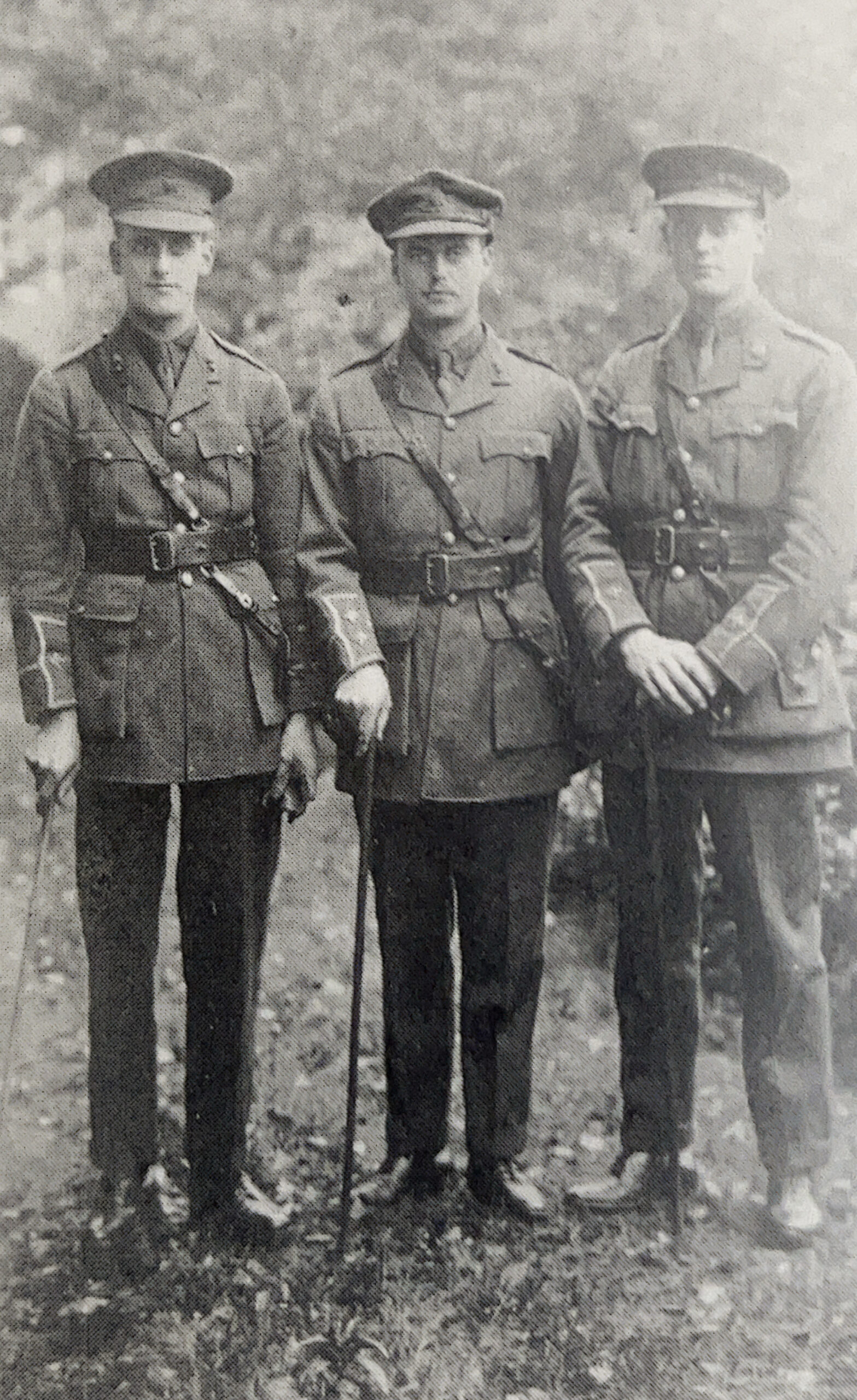
Cuthbert was commissioned into the Royal Field Artillery in July 1912. In August 1915, Gerald interrupted his education at University College, London to also join the RFA; in the following month, Carteret enlisted, joining the Army Service Corps. All three sons survived the war.
Having rejected the suggestion that she should become a V.A.D. during the war, Dorothy trained a a nurse at University College, London. After the war, now a qualified nurse, she worked in both public and private hospitals, and then trained as a midwife, before moving to Cairo to work in the Anglo-American Hospital, where she met Oliver Moriarty, an Irish barrister. They married in 1922 and had two sons. Dorothy died in 1993, aged 103, having published her memoirs a few years earlier.
At the 1921 census, Alice and Bernard were still living at Clarence Place, with Grace Wood, now a retired servant aged 69, with two young servants.
Death
Alice died at 38 Clarence Place, Gravesend on 15 December 1933, aged 70. The causes of death were heart failure and lumbar myelitis.
Her funeral was held at the Roman Catholic part of Gravesend Cemetery, on Monday 18 December, when she was interred into the family mausoleum; the mourners included Bernard, Cuthbert and Dorothy. (The brief report of the funeral does not mention her two younger sons.) The report in the Maidstone Telegraph on 23 December is headed “Assisted Famous Author” and reports that:
the manuscripts of most of the early books of Dr. R Freeman of Gravesend, the famous author were typed by Mrs. Bishop, who was acquainted with Dr and Mrs. Freeman for a very long period.
Relationship with Richard Austin Freeman
In her autobiography, Dorothy Moriarty talks frequently of her parents’ relationship with Richard Austin Freeman (1862–1943).
Freeman had trained as a doctor, and joined the Colonial Service in 1887 as an assistant surgeon in West Africa, before joining the expedition to the Ashanti region of the Gold Coast (now Ghana) in December 1888. After a bout of black water fever, he returned home to recuperate, and was discharged from the service in 1891. On his return to England, he worked at the Middlesex Hospital before setting up as a general practitioner in Wimbledon.
Following the scandal around the relationship between Alice and Richard, both families moved away. Richard Freeman took rooms at Cliffords Inn in London, where he started writing.
As Dorothy says:
At about this time, Richard Freeman took chambers in Cliffords Inn and got down to the business of writing. Then at intervals, he paid visits to our house in Gravesend. So our mother, now an indispensable part of his life, spent her time commuting between Clifford’s Inn and our house in Constitution Crescent, helping, advising and later typing his work on her portable Blick typewriter. As his books rolled out of the printing press they corrected proofs together.Page 37
If you have read his books, you will have noted that his heroines are all of one type and I believe that they are a record of how he saw our mother. They are handsome and intelligent but with no sense of fun, no inconsistencies, no passion. Not our mother as we knew her but probably the woman he saw mirrored in his precise and formal mind.Page 38
As well as working together on his books, the couple would go for walks or bicycle rides and picnics in the Kentish countryside.
Dorothy continues:
A strange couple in many ways. Did Richard love my mother or did he look on her as a promoter? Content to stay in the background? Was her belief in him a part of his inspiration and driving force? Nanny never said anything. I always felt there was a very special relationship between her and my mother that even the wedge of Richard Austin Freeman could not split, but she never smiled on him as she did on her other guests. Her wooden face remained wooden.Page 38
In about 1900, Richard suffered a complete breakdown in his health and gave up medicine for writing.
I was nine years old … when a major crisis occurred that brought us into intimate contact with the Freeman family. Richard was paying our parents one of his periodic visits when he became suddenly and gravely ill. Perhaps this illness was somehow connected to the black water fever he had contracted during his service in Africa. In any case, consultation followed panic and we were told that Nanny would take Gerald and Carteret to her cousin in Tunbridge Wells and Cuthbert and I would stay with auntie Austin Freeman in Ramsgate.Pages 38-39
Meanwhile, my mother and Richard Freeman’s colleagues from the Middlesex Hospital were fighting hard to save his life. They succeeded and by doing so gave Dr Thorndyke, the principal character of his subsequent scientific detective stories, to the world of fiction.Page 40
We returned home to find a gaunt and shaky edition of our parents’ guest looking as if he had returned from the grave. The dark aquiline good looks, the magnetic fire of the dark eyes, were changed and dimmed by the ordeal of a desperate sickness.Page 40
Richard initially recuperated at the Bishop family home in Constitution Hill, where he and Alice would look down to the ships on the River Thames.
Richard Freeman was a fanatical lover of ships. He knew all the rigs and all the details of every rig. He made models of ships and his favourite pub was the Ship and Lobster, a grubby little building on the edge of the marshland that stretched to the Hundreds of Hoo and beyond. The two telescopes were a great help in his convalescence because, for a mind like his, activities of all kinds were a necessity. Condemned to inactivity of body he was content to pause and dream and look through the telescopes that could bring his beloved river to him.Page 41
What did my mother think when she first looked at Richard Austin Freeman with her wide intelligent grey eyes? Was there electricity in the air? The warning rumble of thunder? My conviction is that almost from the beginning she saw him as an extraordinary man, someone at whose feet she could sit, yet someone she could direct and dominate. Did they become lovers in the usual sense? Or was sex overruled, sublimated to the making of a new writer? I am quite sure she saw him as famous long before Fame arrived. I am almost equally sure that underneath his magnetic personality was a cold and calculating mind. For in my mother‘s hands was my father‘s cheque book. A strange eternal triangle.Page 41
And yet a partnership (let us acknowledge it) that enriched three lives, for in the end my father also basked in the reflected fame of Richard Freeman. My father was a stockbroker. Did he perhaps look on Richard Freeman as a gilt edged investment? It was not many years before he broke into the world of detective fiction and in the first book to make his name, The Red Thumb Mark, [published in 1907] my father’s assistance in photographic experiments is acknowledged.Page 42
In 1902, Bernard Bishop purchased a house at 2 Woodville Terrace, Gravesend, in which he had been born, into which the Freemans moved and settled.
The arrangement was that Dr Freeman would provide free medical care and free education as our tutor in exchange for a roof for him and his family – and everyone’s face was saved.Page 42
Over the next decade, Richard’s fame increased as his books became best sellers, while the fortunes of the Bishop family declined with the bankruptcy and death of William Henry Bishop and the enforced move to the “mean little house” at 38 Clarence Place.
I have often wondered how my mother felt about this readjustment of the seesaw. Now Richard was way up amongst the stars and she was way down, caught in the trivia of daily worries and petty economies. He was completely independent. He had his own house, his own circle of friends and his own interests. Her typewriter was the strongest link between them, for she still typed all his work and corrected his proofs but now she only shared where once she had possessed.Page 76
Some Facebook and YouTube articles suggest that Richard Austin Freeman was the father of Gerald Bishop. This is considered unlikely in view of the dates, although it is probable that Richard and Alice became lovers later.
Sources
Ancestry.co.uk:
1871 England Census
1881 England Census
1891 England Census
1901 England Census
1911 England Census
1921 England Census
Epsom & Ewell History Explorer: Children of the Clergy
Maulefamily.com: Maule Family Tree
Maidstone Telegraph:
23 December 1933. Assisted Famous Author. Death of Mrs. B.E. Bishop
Moriarty, Dorothy (1991).
Dorothy: The Memoirs of a Nurse. Ealing, London: Corgi Books. ISBN 0552994634
Morning Post:
22 November 1889. Births
Image credits
Alice with her mother: Epsom & Ewell History Explorer
Three brothers in uniform: Dorothy: The Memoirs of a Nurse. p.96