Part of the Ingram-Green family tree (Great-great-grandfather)
Family background and early life
Thomas Carteret Maule was born in 1817 in the Copnor district of Portsmouth, Hampshire. He was the seventh of nine children born to William Henry Maule (1781–1848) and his wife Alicia Ordidge née Sheppard (1778–1861). He was baptised on 28 November 1817 at St Mary’s Church, Portsea.
William Henry Maule had been born in Greenwich and married Alicia Sheppard (from Portsmouth) on 4 August 1804 at Stoke Damerel near Devonport Royal Navy Dockyard. William was employed as a clerk in the Royal Navy pay office and his work took him to the main naval dockyards in southern England. Thus, of his nine children, the eldest was born in Devonport, followed by five children born in Sheerness, Kent and then the youngest three at Portsmouth, all close to Royal Navy dockyards.
Thomas’s brother, Richard (born in 1811) was a lieutenant in the Bengal Artillery and was killed in November 1841 near Kabul in Afghanistan. The circumstances of his death were reported thus:
Under the command of Lieutenant Richard Maule, Bengal Artillery, the so-called ‘Kohistan Rangers’ were part of Shah Shuja’s force. [James] Rattray himself left Kohistan in September 1841, but Maule, his subaltern and sergeants were murdered by the troops under their command on 3 November 1841 at Kahdarrah.
Education and university career
There is no record of Thomas’s early education.
On 29 June 1835, when Thomas was 17, he was admitted to St John’s College, Oxford as a probationary scholar. Three years later, on 28 June 1838, he was admitted as a Fellow of St John’s. He graduated as Bachelor of Arts (3rd Class) on 28 November 1839.
At the first national census on 6 June 1841, he was recorded as resident at St John’s College; his occupation was shown as “clerk, B.A.”
He was awarded Master of Arts on 9 February 1843, and Bachelor of Divinity at the University of Oxford on 25 May 1848.
Clerical career
Thomas was ordained as Deacon at Christ Church, Oxford on 6 June 1841. The ordination ceremony was conducted by the Bishop of Oxford, Richard Bagot. A year later, on 24 July 1842, he was ordained as priest; the ceremony was held at Chester Cathedral and conducted by the Bishop of Chester, John Bird Sumner
The first known clerical appointment was as curate to James Geldart at All Saints’ Church, Kirk Deighton, near Ripon, Yorkshire. On 1 December 1849, Thomas is recorded as assisting at the service of re-dedication of the church, when this was re-opened after a major renovation ordered by Geldart.
At the census in March 1851, Thomas is listed as living at a cottage adjacent to the rectory at Kirk Deighton. Staying with him was his sister, Elizabeth Egan, whose husband, William, was a solicitor.
Thomas had left Kirk Deighton by the end of 1853, as his successor as curate (Rev. S.H. Garsford) was appointed in January 1854. Thomas had now returned to Oxford to take up the position as the vicar of St Giles’ Church; he was also appointed Bursar at St John’s College.
In October 1856, Thomas was installed Rector of Cheam in Surrey, which was in the “gift” of St John’s College. The annual income from the appointment was assessed at £559.
On 6 October, his successor at St Giles, Revd G.M. Bullock, was inducted into the vicarage.
Shortly prior to his departure from St Giles, Thomas had made a “handsome donation” to the church, to be applied “to any purpose which was deemed most desirable” by the parishioners. As Thomas had previously expressed his opinion that the Communion plate, being “poor in design, ill executed and in bad condition”, should be replaced by a service “more worthy of the church and parish”, the vestry decided to raise further funds to enable the church to “carry into effect his known wishes on the subject”.
Over a hundred guineas were raised which, with the addition of Thomas’s gift, enabled the purchase of “a very beautiful service of Communion plate” with which Thomas celebrated the Eucharist at his final service in the church. In addition, to “show their affectionate regard” for Thomas and his services to St Giles, the senior members of the congregation presented him with a “large and splendid timepiece … in the Louis Quatorze style”.
St Dunstan’s Church, Cheam
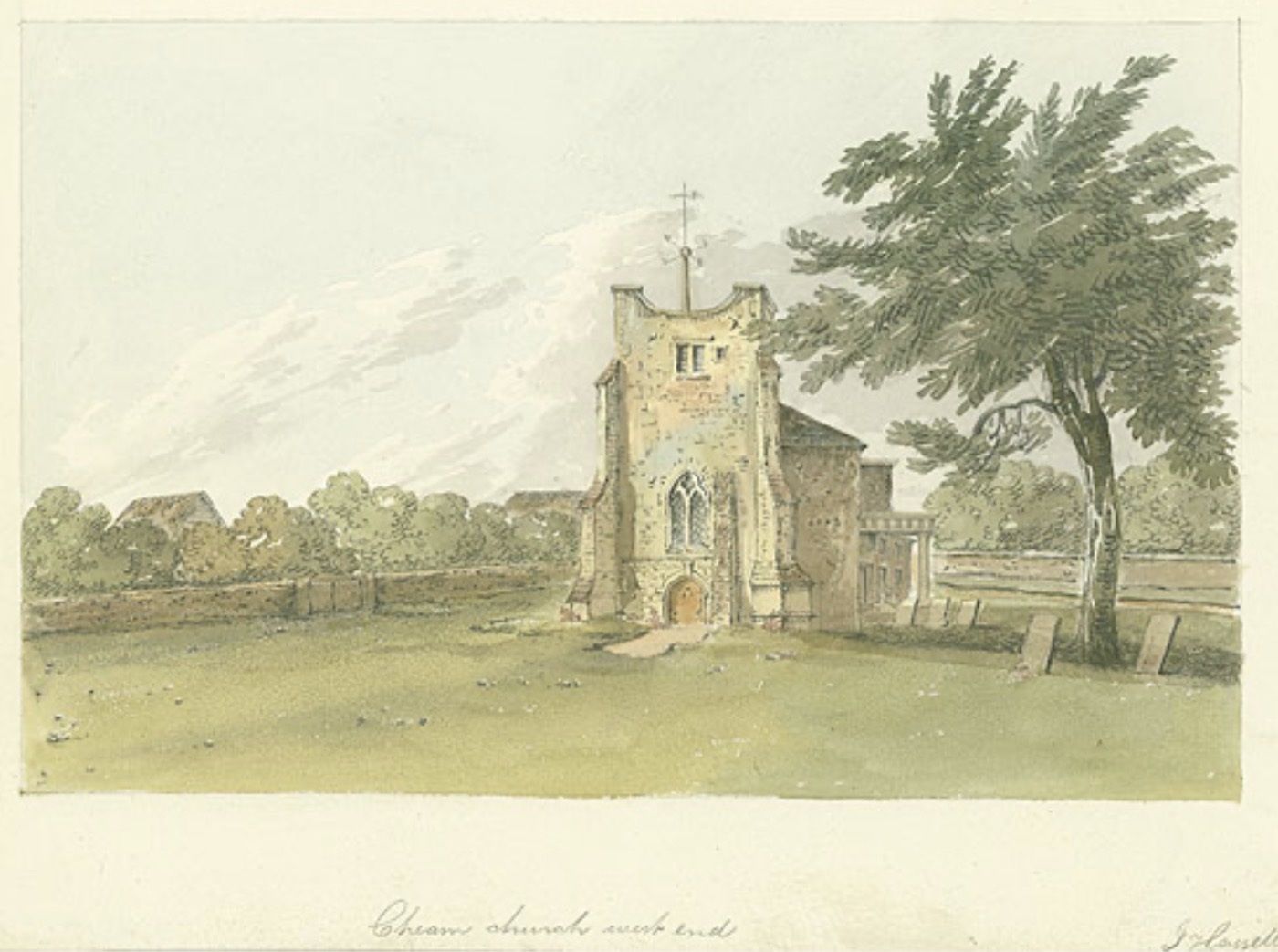
In 1862, Thomas Maule initiated the replacement of St Dunstan’s Church, Cheam. The original medieval church was now in need of repair and was too small to meet the needs of a rapidly growing local population.
The new church was built immediately alongside the old church, which was then demolished leaving only the former Lady Chapel, into which the memorials from the old church were moved. The resulting chapel is now known as The Lumley Chapel and is a Grade II* listed building.
To fund the building of the new church, Thomas obtained a grant from the Incorporated Church Building Society in June 1862. The balance of the building cost had to be financed by donations, but in February 1864, the church applied for a Church Rate of £750. This was very controversial and was only carried by a vestry vote of 74 in favour with 45 against. The total cost of the building amounted to about £5,200.
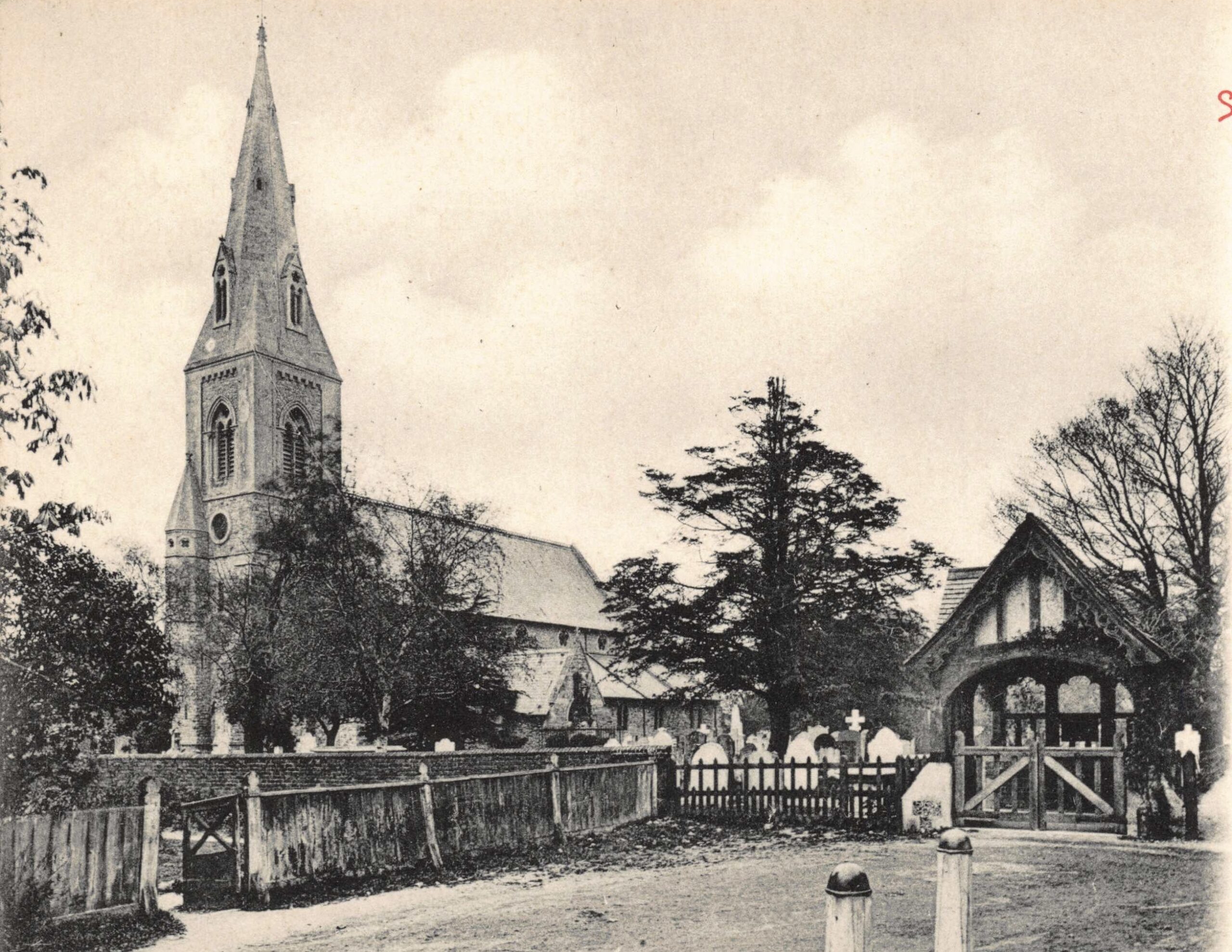
The church was built with Kentish ragstone below pitched slate roofs, with dressings to the windows and doors in Bath Stone. It was designed by F. H. Pownall in the Gothic revival architectural style, and features polychrome brickwork decoration internally. The builders were Sharpington & Co. of Westminster. The church was considerably larger than its predecessor, and could accommodate up to 700 persons.
The new church was consecrated on Thursday 17 November 1864 by the Bishop of Winchester, The Right Reverend Charles Sumner, who was met at the entrance to the church by Thomas, who led the bishop and his entourage to their seats by the altar. After the service of consecration, Morning Service was held, led by Thomas. The Bishop’s sermon was taken from the text of the 14th Chapter of St John’s Gospel, “In my Father’s house are many rooms…” At the end of the service, the collection raised £151 towards the church building fund, including a £20 donation from the Bishop.
The new church was not universally popular and many criticized the decision to demolish the old church rather than repair and improve it, especially as it had only been extended as recently as 1839. The verbose London correspondent of the Dublin Evening Mail wrote on 13 December 1864 about his visit to the church and his shock at seeing the remains of the former church standing alongside the new.
The roof has been removed and within, upon the walls, figures are painted in every direction, announcing that what but recently was a house of prayer has been sold piecemeal as so much old materials. The west window for instance, with carving such as the stonecutters of the present day rarely achieve, is rudely marked, “Lot 47”. The great door below, through which generations of dead and gone parishioners have passed to baptism, to marriage, eventually to the grave, is labelled shortly, “Lot 46”. The end wall of the other end of the building is divided, doubtless for convenience of sale, into two parts; the divisions being marked by the crown of the arch above the point where the communion table stood. Each purchaser consequently has the right to half the Ten Commandments, which yet repeat their moral lesson to all who enter the enclosure, regardless of the destruction that has been gone on around them.
…even the humblest rustic in the neighbourhood regrets and feels [this havoc] to be out of keeping with his sense of what is fitting…
It is said that there has been a good deal of squabbling in the parish and that the step which strikes every non-parishioner with amazement would not have been adopted had a better spirit prevailed. It ought, however, to occur to the powers that be, that they are taking the worst possible mode of inculcating regard or veneration for their own works when they exhibit such a striking want of respect for the works of their predecessors.
Marriage and children
Within nine months of his installation as Rector of Cheam, on 18 August 1857, Thomas Maule, aged 38, married 22-year old Julia Fanny Bockett at St Martin’s Church, in Epsom, where her father was the long-serving vicar.
The couple’s first child, Henry Carteret was born at Cheam Rectory twelve months after the wedding, on 26 August 1858, followed by Alfred on 5 February 1860. As a Church of England priest, Thomas undoubtedly had his children baptised into the Church, but the baptism register for Cheam parish appears to be lost.
At the 1861 census, the family (Thomas and Julia with their two sons) were living at Cheam Rectory, with three servants: a cook, a housemaid and a nursery nurse.
The next two children were daughters: Alice Elisabeth Fanny, born 23 April 1863, and Lilian Mary, born 9 October 1864.
Death and funeral
Thomas Carteret Maule died at Cheam Rectory on 29 March 1867, aged only 48 years. The cause of death was recorded as Laryngitis (36 hours).
Thomas was an energetic and well-respected and loved rector, and his death resulted in “widespread grief and dismay” in and around Cheam. The funeral was held at St Dunstan’s Church on 3 April; the service was conducted jointly by the Revd. John Richard Vernon, his brother-in-law (husband of Julia’s sister, Augusta), and the Revd. Robinson Thornton, headmaster of Epsom College (also of St John’s College), with many clergymen present. In accordance with the wishes of several parishioners, there was a celebration of Holy Communion after the funeral, and morning prayers were read.
Subsequent family history
Just under nine months after Thomas’s death, Julia gave birth to her fifth child, Carteret, on 19 December 1867, born in Tunbridge Wells, Kent.
His widow, Julia was obliged to leave the rectory on Thomas’s death and initially lived in Tunbridge Wells, before retiring to Hove in Sussex. She survived her husband by 25 years and died at Lourdes, France on 3 December 1892.
Henry Carteret Maule married an Australian, Mary Anderson, in New York in 1886, and had one son. He later returned to England and worked as a clerk for the Admiralty. He died in Suffolk in 1940.
Alfred Maule married Maria Wilford in 1892, with whom he had two sons. A brewery manager, he died in Norfolk in 1921.
Alice Elisabeth Fanny Maule married Bernard Edmunson Bishop, a stockbroker, in 1888. She had four children and died in Gravesend, Kent in 1933.
Lilian Mary Maule married William Hamilton, a chartered accountant, in 1890. He was 16 years older than her, and was a widower with two children. She died in Kingston-upon-Thames in 1907.
Carteret Maule married Mary Reidy in 1891 and had five children. He became head brewer at a brewery in Cockermouth, Cumberland, where he died in 1940.
Sources
Ancestry.co.uk:
1841 England Census
1851 England Census
1861 England Census
England & Wales, National Probate Calendar (Index of Wills and Administrations), 1858-1966, 1973-1995
Hampshire, England, Church of England Baptisms, 1813-1921
London, England, City Directories, 1736-1943
Oxford University Alumni, 1500-1886
Surrey, England, Church of England Marriages, 1754-1937
Surrey, England, Church of England Deaths and Burials, 1813-1985
UK, Poll Books and Electoral Registers, 1538-1893
Bucks Herald:
25 October 1856. The Church – Preferments & Appointments
Cambridge Chronicle & Evening News:
6 April 1867. Benefices and Appointments Vacant
Christian Times:
7 December 1864. New Churches
County Herald:
3 December 1864. Consecration of the New Parish Church at Cheam
Croydon Observer:
25 November 1864. Consecration of the New Parish Church
Dublin Evening Mail:
13 December 1864. From our own Correspondent – London
English Chronicle & Whitehall Evening Post:
10 June 1841. Ordination
Epsom & Ewell History Explorer: Children of the Clergy
Find-a-grave: Rev. Thomas Carteret Maule
Halifax Courier:
14 January 1854. Local News
John Bull:
6 February 1864. New Church at Cheam
London Evening Standard:
26 May 1848. University Intelligence
Manchester Courier:
21 December 1839. University Intelligence; Oxford
Maulefamily.com: Maule Family Tree
Morning Chronicle:
18 May 1848. University Intelligence
Morning Herald:
1 July 1835. Oxford University news
21 August 1857. Married
Morning Post:
21 August 1857. Marriages
National Army Museum:
Afghan foot soldiers in their winter dress with entrance to the valley of Urgundeh, 1842
Oxford Chronicle:
30 November 1839. University & Clerical Intelligence
Oxford Herald:
3 August 1867. Sermon Preached at the Funeral of the late Rev. T.C. Maule
Oxford Journal:
22 August 1857. Clergyman Married
6 April 1867. Clergymen Deceased
20 April 1867. Funeral of the late Rev. T.C. Maule
Oxford University & City Herald:
4 July 1835. University & Clerical Intelligence
30 June 1838. University Intelligence
6 August 1842. Ordination
11 February 1843. University Intelligence
22 August 1857. University Intelligence
20 April 1867. The Funeral of the late Rev. Thomas Carteret Maule
Pall Mall Gazette:
22 August 1867. Clerical Appointments & Vacancies
The Record:
18 June 1862. The Incorporated Church Building Society
Sutton Journal:
3 February 1864. Letters to the Editor
Sussex Express:
2 April 1867. Deaths
9 April 1867. The Funeral of the Rev. Thomas Carteret Maule
Western Morning News:
2 April 1867. Clerical News – Vacancies
Yorkshire Gazette:
1 December 1849. Re-opening of Kirk Deighton Church
Image credits
Former Cheam church: Exploring Surrey’s Past
”New” Cheam church: Surrey Archaeology