By Will Ingrams (pen name of Richard Ingram Williams)
 It was the summer of Don Mclean’s Vincent, 1972, and I sported long hair and bell-bottom jeans. I’d completed my degree in Manchester and returned to my parents’ house on the edge of the New Forest, feeling rather lost. After all those years of trudging up a clearly-marked educational trail, though admittedly meandering a little in the last three, I didn’t know what I was supposed to do next.
There was no profession I particularly wanted to take up, and I’d been influenced enough by the hippies and the so-called counter-culture to be chary of career paths and the deadly grind of a daily routine. I missed the student life, my friends and my freedom of movement. I just didn’t want to be here. Fortunately my friend Gareth (actually a peripheral acquaintance I wasn’t sure I knew very well) had invited me to join him on an adventure that might become a trip around the world. His older sister was getting married, and his parents had, very generously, offered G a commensurate sum to spend on the project. He planned to buy a suitable vehicle, kit it out for travelling and set off; it sounded good to me. The departure was vaguely planned for September with the idea of picking grapes in France to earn some travelling cash.
‘You’re sure you don’t want to come on holiday with us?’ My father had a way of instilling guilt, even though I thought myself mature and independent. I was neither, of course.
‘No. I need to earn some money for going away with Gareth. I’ve tried the Post Office, but they don’t need me this year.’ Christmas post rounds and holiday cover had served me well in the past.
‘We’re going to Spain and Portugal this year. You’ve never been, have you?’
‘Only to San Sebastian, with you, but we’re planning to head over the Pyrenees after a while in France. Thanks for the offer.’
‘Chris and Cath are coming.’
Of course they were. My two younger sisters were still at school and locked into family life. I’d escaped, sort of. My parents had a Dormobile and a frame tent, and for the last ten years the summer holiday had involved touring the continent for three weeks, usually including some time in Italy. Mum tended to take so much tinned and dried food that our only sampling of local fare was a daily purchase of bread and milk. The scenery was interesting, and we got a look at European culture, even if we didn’t participate much (I say this with hindsight, because I can’t remember realising it at the time).
‘Pass me the big screwdriver.’ Dad was under the Austin A30 fixing something, and I was supposed to be helping. This rounded olive-green old-timer was my mother’s runabout, and over the years I’d helped Dad equip it with flashers to replace the old flick-out indicators, and a squeeze-the-bulb windscreen washer system to assist the wipers. We’d also dropped the gearbox out several times, because it had a habit of getting stuck in reverse.
‘Well, if you’ve really made your mind up, I’ve got a suggestion for you.’ Dad swore mildly as he dropped the screwdriver, ‘If you’re going to stay here with Nannie you can help her look after the place, and I’ll pay you something to keep the lawns tidy and finish painting the render.’
Nannie was my live-in grandma, my father’s mother, who was in her eighties. She appeared frail and bent, but she was still capable of cooking, cleaning and looking after Jane, the little terrier that had joined the household while I was in Manchester. Dad would probably feel easier if I was around to keep an eye on things, I thought, and the money would be useful. I wouldn’t have to search for a job either.
‘Er, I’d want to go out with my friends sometimes, and maybe away for a few nights if I have to sort anything with Gareth.’ I didn’t want to be chained to the house, and Nannie. ‘She’d be okay on her own for a night or two, but you need to take the responsibility seriously. You’d have to cooperate with her and do your share of things.’
‘Of course. Yeah, sounds good to me.’
We spoke of the money, and Dad was a bit more generous than I’d expected.
Nannie had been there all my life. I remember toddling into her bedroom behind Mum when she delivered tea in the mornings, long after Dad had cycled off to work at the refinery. She had silvery hair and slept in a long white nightgown. Her face and hands were bony and wrinkly, and her fingernails were ridged vertically in a fascinating way, but I think that just made her more interesting. Under the bed she kept a large white chamber pot which she emptied every morning. The upstairs toilet was only six steps from her bedroom door, but I never questioned why she needed a ‘gazunder’; it was just part of being Nannie, along with her china ornaments and the photo of her long-dead husband that she kissed every morning and evening.
I’d come to realise that my parents weren’t totally content to have Nannie living with us. My father would occasionally flare up and tell her so, that his older brother had emigrated to America and left them stuck with her. I think his anger was partly on behalf of my mother, who bore the brunt of accommodating her ways and needs.
Nannie would often come to meet me from primary school, pushing my younger sister in a pram, and later a pushchair. She could usually be persuaded to walk a little further to the village shops for some sweets. When I visited home from university, long-haired and rather arrogant, she would still take me aside and secretly thrust a bag of mint imperials or cough candy into my hand.
All in all, Nannie was ever-present throughout my childhood, and the adult who would often supply sweets, money and affection. She was sometimes a minor nuisance in wanting to kiss me hello or goodbye, or needing something that I had to fetch for her, but I never knew much about what she thought, or what her younger life had been like, because I never asked. Not until that summer.
In the middle of July I booked vaccinations for Cholera and Yellow Fever, then went to visit university friends before my new house and Nannie duties started. It is strange to think oneself back into those days when there were no mobile phones and no internet, a situation difficult for those under thirty-five to imagine. I had written letters to tell people I was coming, several days in advance so they could write back, or telephone, to approve arrangements. I couldn’t phone them easily because most lived in rented places without phones, or were out a lot of the time; in addition there was my dad’s telephobia. He had such a horror of long-distance phone call charges that it was almost impossible to use the home phone for anything but the most local of calls. You had to ask permission and elaborately justify the call, and you were still likely to have him standing by you with an eye pointedly on his watch. It was generally easier to walk up the road and use a public phone box, if you could gather together the necessary change – and there were no alternatives to coins in those days, except for the dreaded ‘reverse-charges’ call. So I wrote letters, and some people had replied or called me back – incoming calls weren’t quite so unwelcome.
I set out as a passenger in the A30.
‘Are you sure you’ll be alright?’
‘Yes, Mum. I’ve hitchhiked loads of times, and I’ve never got stuck. It’s an adventure, as well as a journey. If I’m not getting anywhere I’ll give up and take a coach or a train.’ I hadn’t told her all of my hitching experiences, such as the nutter who picked me and three others up on a snowy day because he wanted more weight over the back wheels; he then careened us all over the road at high speed until we persuaded him to stop and let us out.
‘Well, telephone us tonight from Martin’s, so we know you got there safely, okay?’
Mum was going into Southampton and dropping me on the Salisbury road, so I could head towards Cardiff. I am sure of this because I wrote about it in my diary-cum-notebook, which bears on its back cover a large ‘S. Wales’ sign that I held up that day. Martin, my ex flatmate was at his parents’ in Caerphilly. Two days later he drove me to a road junction suitable for hitching to Manchester.
As well as visiting friends in the Rainy City, I bought a lightweight one-man tent from the Ellis Brigham Outdoor shop near the cathedral, so that I could be independent of Gareth if things didn’t work out well on our big trip. Gareth himself then gave me a lift towards London on his way to Cornwall, where his parents owned a second home. While staying in St Ives, he hoped to track down a suitable Land Rover or similar, for our journey. We chatted while belting down the M6, and made some decisions. We needed to be able to sleep in the vehicle, and to cook, and we had to have a stereo. At that time the fat, clunky eight-track cartridge machine was the established car player, but I’d read that Philips were launching an in-car cassette player. With one of those, we could buy musicassettes, but also record our own music. I wasn’t sure I could get by without Bowie’s Hunky Dory, and my old favourite Chicago Transit Authority. Gareth promised to look into it. The whole enterprise was starting to feel more real.
My dad, a respectable and well-regarded Chemical Engineer, was very good at darts. I discovered this when we were at a holiday camp in Cornwall, in the years before the continental camping trips started. He won the darts competition that week, and told us that he had once beaten the News Of The World Darts Champion in a London pub without knowing who he was. In explanation he admitted that he’d grown up in a pub and had enjoyed plenty of practice. The pub had been called the Black Bull and was somewhere in Kent. I found out later that he had also won a scholarship to a grammar school in Rochester and studied for his degree in night classes, but I don’t think I was particularly impressed, or overly interested, at the time.
Dad welcomed me back from my jaunt with a list of jobs I could undertake to earn a bit more in the two weeks before the family drove off on holiday. The rate of pay wasn’t great, but as I would probably have undertaken them anyway, without being paid, I started the next day, washing the Dormobile and rotavating a patch of the garden.
Later in the week I helped Dad to pack everything into the camper van, and on the Saturday morning I got up early to see them off. Then I went back to bed. For the last few years Nannie had not been sleeping upstairs, but in a rented room several houses away – our bedrooms were all needed by growing children. She would arrive at about ten in the morning to spend daytime with the family; I would often take the dog along when I accompanied her back to Mrs Houghton’s at about ten o’clock in the evening. That Saturday I returned with her to carry suitcases for her stay in the family home, and we settled into a sort of routine. I took her a morning cuppa, but Nannie prepared lunch and tea in the evenings for both of us, unless I was out. I didn’t have a full driving licence then, and my Vespa scooter was not in a roadworthy state, so I relied on others for transportation.
My local friends were old school mates, most of whom had been away at university, but there was also Jim, who had entered the world of work and had a white Mini. He seemed happy to drive us around, and I was happy to let him. He also helped me with some of my tasks, not least fixing the gearbox in the A30, which had jammed again before the family left.
Nannie and I chatted during the day, and often watched television together in the evening, if I was around. The colour TV set was pretty recent – installed while I was away at university – but many programmes were still broadcast in black and white. Nannie particularly liked Ironside, with a wheelchair-bound Raymond Burr, who I’d been used to watching as Perry Mason. If it was raining, or I’d had enough of mowing and painting by mid-afternoon, I’d have a go at baking a cake. I’d produced my first ever Dundee fruit cake on Saturday afternoon, the twelfth of August, and we were eating slices of it after tea on the following day, when Nannie started to tell me the story of the labelled haycock, which amused her in recollection. I couldn’t remember her ever speaking about her childhood before, but over the next two hours she told me a lot about her life at the end of the nineteenth century and the beginning of the twentieth. I can read, now, in my little diary’s entry for that day, I must write some of this stuff down… before several pages of notes on the tales she told me that evening. By typing now, in 2021, parts of my grandmother’s childhood, as told to me in 1972, I can pass them on for my grandchildren to read, perhaps in fifty years’ time. In this way her childhood memories can bridge almost two hundred years and five generations.
‘Father was driving in the pony and trap, along by the river, when he was hailed by the postman. He said he was carrying a letter for him, and it would save his legs the walk to the house.’
‘Which river? Where did you live?’
‘The farm was in Ilford, near Barkingside, I should say.’
‘Your dad was a farmer?’
‘Oh, yes, a gentleman farmer. He had men to do the work, of course, and foremen to oversee it. Father would drive in the trap between the two farms.’
‘You had two farms?’
‘Yes, we did, as a family. We lived at Hedgeman’s Farm, in the bigger house. Uncle Lamb lived in the other. It was a field and two meadows away.’
‘So when was this?’
‘Well, let me see. I was born in eighteen eighty-eight, so I’ll be remembering the eighteen nineties, I should think. When I was growing up.’
‘And which river was it?’
‘That would have been the River Roding, I reckon, or one of the streams that flowed into it. But anyway, it was a wild, stormy day when he met the postman, and before he’d got much further the letter blew out of his hand. It fluttered away and was lost – he couldn’t chase after it. So he went on his way and forgot about it. Now that evening, the storm got worse and it rained all night. A terrible storm, it was. When morning came, all the meadows down by the river were flooded. Under water.’
‘Was this in the winter, then?’
‘No, in the summer, prob’ly eighteen ninety-eight I should think. The haycocks had been stood up in the meadows drying out, until that storm came along. But early in the morning, a policeman came knocking on the door, asking for my father. He said that one of his haycocks was stuck under the bridge, washed down and blocking the flow of the river, and would he send someone down to pull it out and bring it back? So my father says ”And what makes you think it’s one o’ mine?”, so the policeman tells him it had a label on it, and gave him the letter he’d lost the day before! My father burst out laughing.’ So did Nannie at this point, and she had to pause before she could finish the tale. ‘My father, he couldn’t be bothered with it, and told the policeman he could take the haycock for himself if he wanted. You should have seen the bobby hurry off to claim it!’
‘Was the letter important?’
‘No, just a local tradesman’s account – but it’s a good thing it was written in pencil, eh?’ She chuckled again.
That was just the start. I had more questions, and Nannie had plenty of tales to tell. I made us another cup of tea and we spent a couple of hours, still at the tea table, while she reminisced.
She told me more about their house. She said it had formerly been Queen Anne’s shooting box, and was not far from Boleyn Castle; Uncle Lamb’s house was where the Queen’s chapel used to be. The house had thirteen windows at the front – four on the ground floor, five upstairs and four more at the top (I imagined these as dormer windows in attics for servants, but that was just speculation). There were five flower beds set into the lawns on either side of the drive that led to the house, three round and two square, and the gardener wouldn’t let the girls pick any flowers from these beds – they had to gather them from the back of the house, where he grew duplicates. A chase led to the summerhouse. The nursery had twelve tall cabinets built into the walls, which they used for hide and seek and other games; the room had once been the gun room for the shooting box. Nannie told me that there had been a blocked-up doorway in the cellar, and she found out later, after the house had been pulled down, that it had led to a secret passage that linked to the chapel and the castle.
My notes from that evening have sat in drawers and attics for nearly fifty years, and I hadn’t checked on any of these details until yesterday. With the benefit of the internet, it didn’t take long to discover that Boleyn Castle was actually Green Street House, a stately home associated with Anne Boleyn by local legend. In Nannie’s childhood it seems to have been owned by the Catholic Church and then leased to West Ham Football Club in around 1916 – their Boleyn Ground was adjacent, and their badge featured a castle tower based upon it. The castle is not there any more. A second football connection I discovered is that Barkingside Football Club, formed in 1898, actually played their early matches at Hedgeman’s Farm. Nannie didn’t mention that.
Nannie told me the tragic story of her eldest brother James. He joined the army when he was seventeen and fought in the Boer War. He was a very good horseman and tamed a difficult horse that no-one else had been able to ride – he blindfolded it, apparently. He was given this mount as a reward, but one day they were caught in a veldt fire and the horse panicked, bolting and injuring himself and James. The rider recovered, but the horse had to be shot.
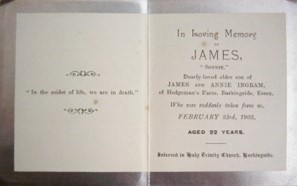
James survived the war and returned to England, but three months later, in February 1903, he joined a shooting party from the farm. Already mounted, he asked one of the farm lads to pass him up his gun. It was offered to him barrel first, and as he took the gun the trigger caught on something, and he was shot through the heart. He was twenty-two years old.
When we cleared out my parents’ house in 2001, we found bundles of old documents and keepsakes. Among them was a card from James Ingram’s funeral at Barkingside Holy Trinity Church. Online maps show that, amid all the houses, shops and streets that now cover that area, the church is still there.
James (affectionately known as Sonnie) was the first child of James and Annie Ingram, Nannie’s parents. His mother was born Annie Clark Bosworth in 1858, and we also found a needlework sampler that she had sewed very competently in 1864, when she can’t have been more than seven years old. Annie died in 1916.
‘We used to take the men their beer, you know, at harvest time.’ Nanny had been gazing into the distance for a minute or so, but was stirred again by this recollection. ‘My sisters and I, we carried it out and poured the mugs. Three times a day, in the harvest fields. The younger boys would have minerals.’
‘That was a busy time, I should think.’
‘Oh, yes. We all had to help out, Dad too, even if he had horses in.’
‘Horses?’
‘Yes, he used to take in sick horses and bring ’em back to strength. All the brewers and the merchants would bring us their poorly horses. We were noted for it. We had two stable blocks, one for our horses and one for them.’
The equivalent of booking your car in to be fixed, I thought, except that it probably took longer. I’d never thought much about a horse-centred transport system. It must have been very different.
One of the things Nannie had told me previously was that she hated her name, Mildred. She wished she’d been called Millicent, which was a much prettier name. They both shortened to Millie, though, and that was mostly what she’d been called. Her older sister was Queenie, but she didn’t tell me what that stood for.
‘Queenie married Jamie, and they took a little shop, a confectioner and tobacconist. I used to go and help there in the holidays. Jamie took me for a ride on a tandem, round the streets and into London.’
‘How old were you then?’
‘I must have been sixteen or seventeen, I suppose. That’s how I met Arthur.’
‘Who was Arthur, then?’
‘He was Jamie’s friend. He was sweet on me. Used to chase me round and try to kiss me.’
She wasn’t at all embarrassed to tell me this.
‘I got my own back on him in lots of different ways. Once I put hot cinders in his bag. He was going off to train for his boxing,’ she chuckled again, ‘Burned the tail out of his shirt! He was that cross about it!’
‘Did that put him off, then?’
‘No, of course it didn’t! We used to play tricks all the time, me and Arthur. Jamie too. Queenie never did have much sense of humour. And she frowned on me helping the old lady in the cottage with her shopping.’
I wondered if Queenie might have resented her little sister Millie stealing all the attention of her husband and his friend.
‘Arthur stayed for supper one night, and when I was helping to serve up, I made sure he only got bones and gravy. No meat at all! And then when he asked if he might have a bit o’ meat, we chided him for commenting on his food! And I remember putting water in his bowler hat once.’
‘And he still came back for more?’
‘Oh yes. He was a one. They all said we should marry, Arthur and me. We never did though.’
‘What happened?’
She didn’t tell me. I think she was busy remembering another trick she’d played on Arthur.
‘He was busy with Jamie, and he’d left his coat on the hook. So I took it and opened up the lining, and I hid half a reel of cotton in there. Then I pushed the end of it out through his lapel and sewed it all up again. When he tried to pull the thread from off his collar, he ended up pulling yards and yards of cotton out! He couldn’t understand it!’
It took Nannie a while to get over her amusement. She had tears in her eyes remembering these pranks. She went on to tell me how she and the other girls would play tricks on the cricketers in the summer – sewing up the sleeves of their jackets when they left them in the pavilion.
There must have been more of these stories, but my diary notes, written later that evening, only include those noted above, and yet one more trick she played on Arthur. She’d got him to agree that if she could kiss him while he was asleep, without waking him, he’d buy her a pair of gloves. Arthur, of course, soon pretended to fall asleep, and instead of kissing the cheat, she poured cold water down his neck!
Looking back, I can’t imagine why I didn’t ask Nannie more about her life that evening, or at a later time, but I didn’t. I never found out why she hadn’t married Arthur, or how she ended up running a pub in Kent. I failed to ask my father about it, too, before he died in 2004, with dementia. I can only think that the circumstances and the mood were just right on that one evening in1972, and my young preoccupations were overcome by interest in Nannie’s memories. There is no further mention in the diary of such conversation, and I had forgotten all about that evening, or cast it to the farther recesses of my mind, until we cleared Dad’s house nearly three decades later.
As well as the funeral card and the sampler we found several other documents that firm up some of the dates and places in Nannie’s passage through life. A reminder card shows that Mildred Ingram was confirmed, again at Barkingside All Saints Church, in April 1901, aged thirteen years. And her wartime identity card (from the second of the World Wars she must have lived through), shows that in June 1945 the Williams family left the Black Bull, Cliffe-at-Hoo, Kent, and moved to East Ham, back to the locality of Nannie’s youth.
My parents married in September 1945, and Nannie’s invitation is for Mr and Mrs C. Williams, but her husband died three years later, as letters of sympathy confirm. The ID card change of address shows that she then went to live in The Bungalow, near Sittingbourne, and I remember, as a child, a family trip to take Nannie to visit Annie and George, her old friends. They lived in a wooden ‘chalet’ surrounded by nettles and geese, apparently in the middle of nowhere. There were bead-edged cotton circles over the sugar bowl and the milk jug to keep out the flies. My sister and I shared a high, brass-knobbed double feather bed – I remember this because we wished we were allowed chewing gum so we could see if it lost its flavour on the bed-post overnight; the Lonnie Donegan song must have been current.
I suppose the shallow youth that I was in 1972 was far more interested in keeping up with his friends and saving money for his forthcoming adventure than in understanding more about his family history. I seem to have maintained a similar attitude, because although I photographed those historic documents we found in 2001, it has taken me until January 2021 to piece together those clues with the stories Nannie told me at the tea table forty-nine years ago.
As for that twenty-one-year-old who didn’t know what to do with his life, he did set off, that September, with Gareth, and they did pick grapes in France before journeying into Africa, but that’s another story.
Notes
Uncle Lamb was James Lamb (1839–1903) who lived at nearby Clayhall Farm. He married Mary Ann Ingram, the sister of Nannie’s father, James, in February 1866.
In some respects, Nannie’s recollections were confused or incorrect.
Her memory of the circumstances of her brother James’s death is not quite in accordance with the press report of the inquest. According to the report in the Essex Weekly News of 27 February 1903, James and his younger brother, Ernest, had been gathering cabbages for market. They had a gun, which was used to frighten the rooks off the newly sown peas. Otherwise, this section of the narrative is broadly in agreement with the report.
She has, however, confused the two brothers. It was Ernest (1882–1927) who signed up and fought in the Boer War. His military records list him as Shoeing Smith 22242 Ernest Thomas Ingram of the 81 (Sharpshooters) Company 21st Battalion Imperial Yeomanry.
Although there was a chapel at Clayhall and there may well have been a secret passage connecting the chapel and the house, this is unlikely to have stretched to the former house in Green Street, Upton Park (known as Boleyn Castle) which is about five miles south of Clayhall and Hedgeman’s farms.